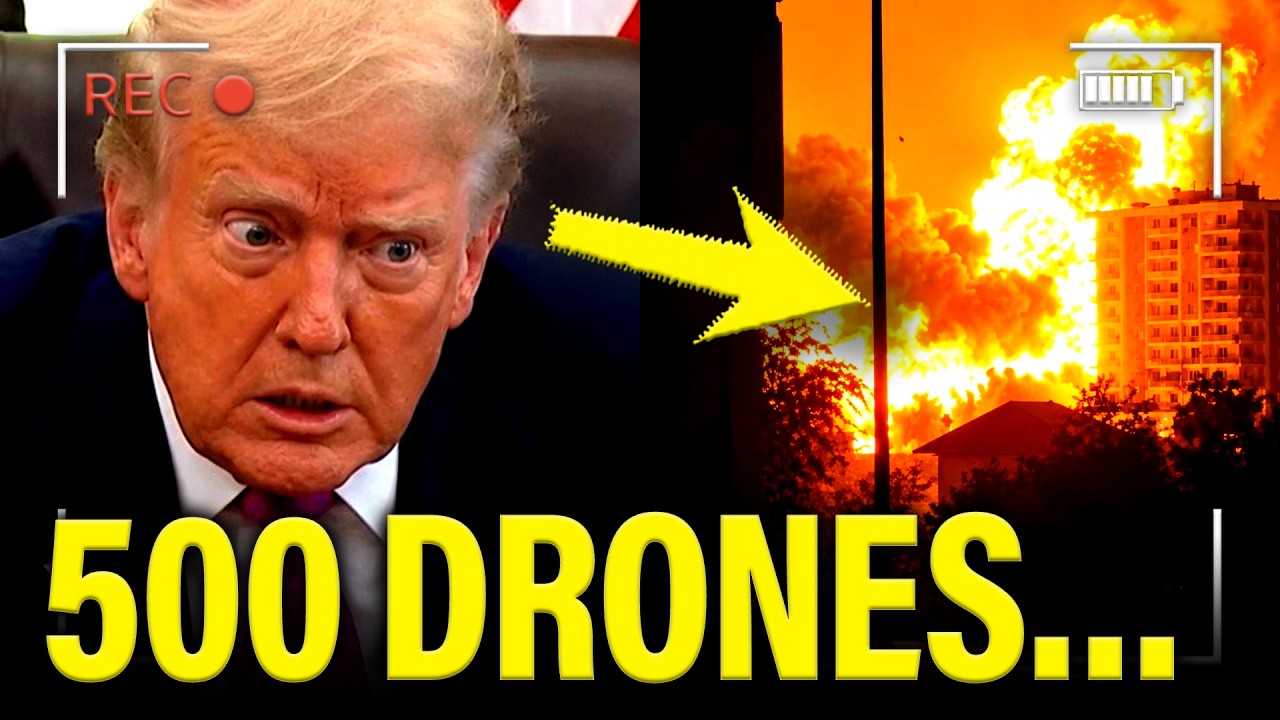
The skies over Eastern Europe have turned into a graveyard of twisted metal and burning debris as Ukraine and Russia engage in the most intense exchange of drone and missile warfare since the conflict began. In a stunning escalation that has stunned military analysts worldwide, Ukrainian President Volodymyr Zelensky authorized a massive offensive involving approximately 500 drones launched deep into Russian territory.
This unprecedented swarm targeted critical infrastructure, oil facilities, and military airfields, marking one of the largest single-day drone operations in modern warfare history. However, the celebration of this tactical achievement was short-lived, as Vladimir Putin retaliated with a ferocity that has left Ukrainian cities reeling and civilians mourning in the streets.
The 500 Drone Swarm: Ukraine's Deep Strike Strategy
The operation was nothing short of audacious. Ukrainian forces unleashed a coordinated barrage of unmanned aerial vehicles designed to overwhelm Russian air defenses and strike at the heart of the Kremlin's war machine. The targets were not random; they were carefully selected to cripple Russia's logistical capabilities and economic stability.
Reports indicate that the swarm successfully reached the Black Sea resort area of Sochi, a location far from the front lines that has largely been insulated from the war's immediate dangers. The drone strikes caused significant impacts in Samara, a region located approximately 900 kilometers from Ukrainian-controlled territory, demonstrating a remarkable leap in Ukraine's long-range strike capabilities.
Two oil facilities and a military training ground were identified as primary targets. Oil refineries are the lifeblood of the Russian economy, funding the very war effort that threatens Ukraine's existence. By striking these facilities, Ukraine aims to drain the financial resources required to sustain Putin's invasion. Furthermore, strikes on airfields in the Bryansk region suggest a strategic effort to neutralize the launch platforms for Russian drones and aircraft.
Innovation in the Skies: The Flamingo and Long-Range Drones
Central to Ukraine's success has been its rapid development of indigenous drone technology. The "Flamingo" series, including models like the FP1 through FP9, has become a symbol of Ukrainian ingenuity. These Firepoint drones are not just simple quadcopters; they are sophisticated long-range strike weapons capable of traveling distances that were previously thought impossible for a nation without a massive military-industrial complex.
The ability to strike targets 900 kilometers away, and in some documented cases even further into areas near Siberia, changes the strategic calculus of the war. It forces Russia to spread its air defense systems thin, trying to protect assets deep within its own borders. The FP series represents a shift from asymmetric guerrilla tactics to high-tech, precision warfare.
However, the Russians are not standing still. The conflict has become a crucible of innovation, a technological arms race where adaptation is the difference between survival and annihilation. While Ukraine innovates with the Flamingo, Russia has introduced the Geran-4 and Geran-5 drones, creating a new nightmare for Ukrainian air defense.
The Geran Threat: Russia's Deadly New Arsenal
The days when Ukraine could boast a 90% interception rate against Russian drones are gone. The introduction of the Geran-4 and Geran-5 has fundamentally altered the air war. Unlike the slower, propeller-driven Shahed drones that were relatively easy targets for machine guns and older air defense systems, the new Geran models are jet-powered beasts.
The Geran-4 travels at significantly higher speeds, making it a difficult target for traditional interception methods. The Geran-5 is even more fearsome, described by experts as a hybrid cruise missile. These are not merely drones; they are precision-guided munitions capable of evading radar and striking targets with devastating accuracy.
The statistics are chilling. Interception rates for the Geran-4 have plummeted to roughly 50%, and the numbers for the Geran-5 are even grimmer. This technological gap has forced Ukrainian pilots into incredibly dangerous tactics, such as using MiG-29 fighter jets to physically intercept these drones.
We have seen spectacular footage of Ukrainian MiG-29s flying at low altitudes, attempting to shoot down these jet-powered drones with cannons. This is a high-stakes gamble. When a jet traveling at hundreds of miles per hour shoots at a drone packed with explosives, the resulting explosion creates a debris field that can severely damage the attacking aircraft. The risk of the MiG-29 flying through the ball of fire and debris is immense, leading to catastrophic crashes and loss of precious pilots.
Putin's Revenge: A Birthday of Bloodshed
As the sun set on the drone strikes, Russia prepared a devastating response. It was Vladimir Putin's 74th birthday, and the Kremlin seemed determined to mark the occasion with a display of raw power. According to Russian defense officials, a massive land, sea, and air strike was launched against Ukrainian defense industry sites.
The targets included facilities linked to the production of the Flamingo cruise missiles and drones, as well as port and ship repair facilities in the Odesa region. However, the brutality of the response was felt most keenly in civilian areas. In the Chernihiv region, specifically in the town of Pryluky, a ballistic missile tore through a five-story residential building.
The aftermath was horrific. The regional governor confirmed that the casualty count ranged from 20 to 25 dead, including a heartbreaking number of children. Reports indicate that five children were killed, including three one-year-olds and an eight-year-old. Over 55 people were injured. The image of a children's art center reduced to rubble stands as a grim testament to the indiscriminate nature of Russia's wrath.
In Kyiv, the Darnytsky district saw fires rage at a garage cooperative, killing two. In the Kryvyi Rih region, two more were killed in Oleksandriia. In Zaporizhzhia, missile strikes damaged apartment buildings, leaving at least one dead. The psychological impact of these attacks is profound. Residents of Kyiv are once again sleeping underground in metro stations and parking garages, seeking safety from the terror raining down from the sky.
The Strategic Calculus: Production and Interceptors
The war in Ukraine has exposed a critical vulnerability in the West's military strategy: the economics of interception. Former Soviet naval officer and analyst Andrei Martyanov highlighted a terrifying disparity in production capabilities. The United States produces approximately 2,000 Patriot interceptor missiles (MIM-104) per year. By 2033, the US might have 10,000 new interceptors.
In stark contrast, Russia is producing an estimated 36,000 Geran-4 and Geran-5 drones per year. This is a numbers game that the West is currently losing. Even if every Patriot interceptor hit its target—a statistical impossibility in real-world combat—the sheer volume of Russian drone production would overwhelm Ukrainian defenses.
This mismatch reveals a fundamental flaw in Western military spending. While the US pours billions into massive aircraft carriers and nuclear submarines—assets that are increasingly vulnerable to drone swarms—Russia is focusing on mass-producing cheap, effective, and modern warfare weapons. A billion-dollar battleship can be disabled by a few well-placed drones; a $50,000 drone can destroy a multi-million-dollar tank. The paradigm has shifted, and the West appears to be lagging behind.
The Iranian Connection and Geopolitical Shifts
The conflict is not isolated. Iran, which originally supplied the Shahed drone technology to Russia, is now seeking upgrades.
Iranian President Masoud Pezeshkian is set to meet with Putin at the upcoming CIS meeting to discuss further cooperation. Iran has successfully developed its own cutting-edge ballistics and drone technology, storing them in underground cities buried deep within mountains—unlike US bases in the region, which are exposed and vulnerable.
This alliance of sanctioned nations—Russia, Iran, and North Korea—is sharing technology and resources, creating a formidable axis of military power that is effectively bypassing Western sanctions. The transfer of Geran-4 and Geran-5 technology back to Iran would signal a dangerous loop of proliferation, making these weapons available to proxy groups across the Middle East.
The Trump Factor and the Risk of Nuclear Rhetoric
Amidst the bloodshed, the political rhetoric in the United States has added a layer of unpredictability. Former President Donald Trump, speaking to the press, casually mentioned a supposed call with Putin to celebrate his birthday and bragged about settling wars and preventing nuclear annihilation.
Critics argue that such rhetoric trivializes the existential threat of nuclear war, treating the potential destruction of cities like Los Angeles and San Diego as fodder for casual conversation. The distinction between political theater and actual statecraft has blurred, leaving many to wonder if the US leadership understands the gravity of the situation.
The delay in delivering promised interceptor licenses to Ukraine has had deadly consequences. Without adequate air defense, Ukrainian cities remain at the mercy of Russian ballistic missiles and drones. The political gridlock in Washington is measured not in votes, but in lives lost in Pryluky and Kyiv.
Conclusion: A War of Attrition and Innovation
The 500-drone swarm launched by Ukraine and the brutal retaliation by Russia underscore a grim reality: this war is entering a new, more dangerous phase. It is no longer just a battle for territory; it is a battle of production, technology, and willpower.
Ukraine has proven it can strike deep into the heart of the enemy, disrupting oil production and military logistics. But Russia has proven it can inflict mass civilian casualties with impunity, using its new jet-powered drones to bypass air defenses and its ballistic missiles to strike without fear of interception.
As the cold winds of winter approach, the target is likely to shift toward energy infrastructure. With cities already experiencing blackouts and people living in metro stations, the humanitarian crisis is set to worsen. The West must wake up to the reality that the industrial warfare of the 21st century is here. It is about drones, electronic warfare, and cost-effective deterrence, not massive battleships.
Until the production gap is closed and air defense systems are provided in overwhelming numbers, cities like Pryluky will continue to suffer. The world is watching a sovereign nation fight for its survival with one hand tied behind its back, while its enemy uses new, deadly tools to rain destruction from the sky.
The war has turned into a slogging match where the price of every Russian drone is paid in Ukrainian blood. The message from the rubble of Pryluky is clear: the world cannot afford to look away, and the good guys are running out of time to turn the tide.


0 Comments