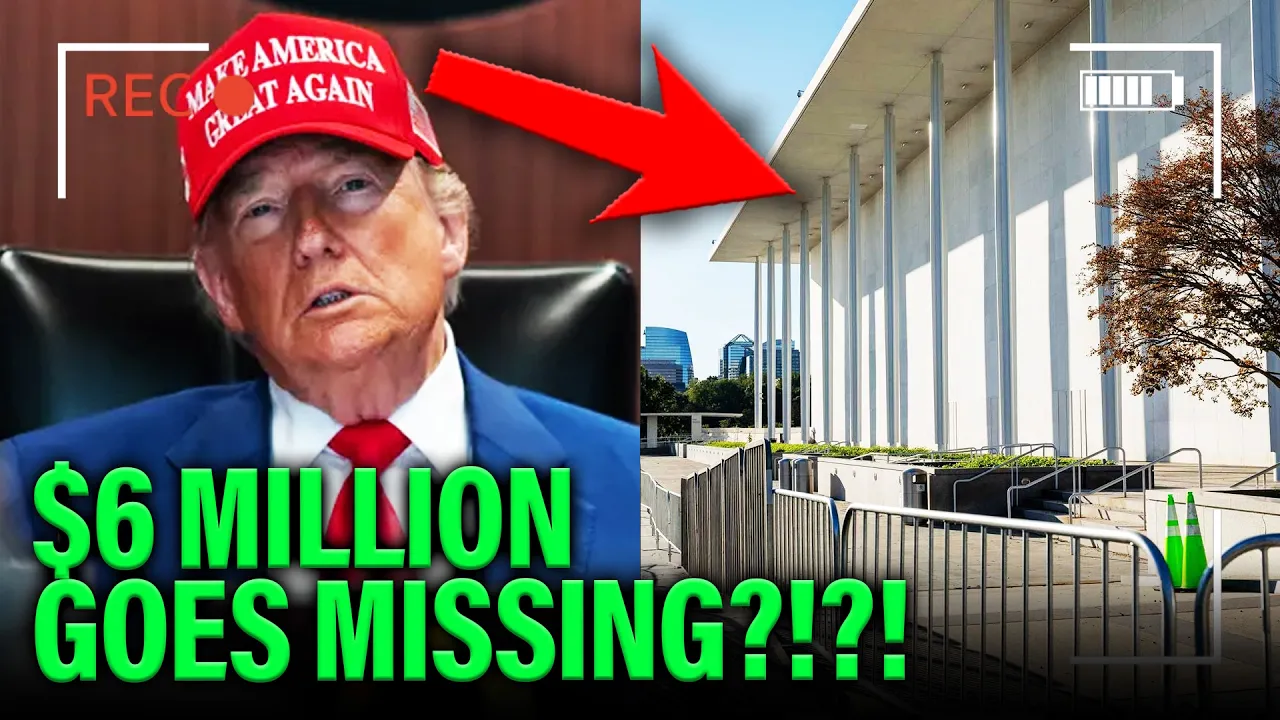
In a political earthquake that has rocked Donald Trump's inner circle, two of his most prominent advisers are locked in a bitter feud over a missing $6 million donation. The scandal, first reported by Axios, pits longtime Trump loyalist Rick Grenell against Alina Haba, the new wife of a Turkish billionaire. At the center of the storm is a promised donation to the Kennedy Center that allegedly never materialized, sparking accusations, denials, and a frenzy of speculation. This explosive story offers a rare glimpse into the murky intersection of power, money, and influence in Trump's Washington—and raises serious questions about the financial dealings of those closest to the former president.
The Players: A Whirlwind Romance and a Political Powerhouse
To understand the feud, one must first understand the unlikely love story that set it in motion. Alina Haba, a 42-year-old political operative with a history of dating politically connected men, met Turhan Milen, a 29-year-old Turkish construction billionaire, at the Kennedy Center just months ago. Milen, described as a close friend of Turkish dictator Recep Tayyip Erdogan, was reportedly scouting business opportunities in Washington. Their whirlwind romance culminated in a lavish wedding at the Waldorf Astoria, attended by MAGA luminaries like Sebastian Gorka, who shared photos of the happy couple on social media.
But the marriage was not just a union of hearts—it was also a union of interests. Milen had his sights set on business deals involving Venezuela, where he operated state-owned cement plants. He sought a softer approach to the Maduro regime, aligning with Rick Grenell, who at the time was serving as president of the Kennedy Center and advocating for a business-forward foreign policy. Grenell, a former acting director of National Intelligence, was a key player in Trump's orbit and had been tasked with reshaping the Kennedy Center's direction.
The Missing Millions: What Really Happened to the $6 Million?
According to Axios, Alina Haba claimed that her husband tried to donate nearly $6 million to the Kennedy Center through Grenell, but the money was never deposited. Grenell vehemently denies the allegation, calling it "absurd." The report states that in the spring of 2025, Grenell persuaded Milen to include a multi-million dollar donation in a lump-sum $17.6 million payment for a business deal involving a U.S. company. Haba later said the figure was actually $5.6 million, and she reportedly has documentation to prove it—documentation that Axios says it reviewed and that the White House now wants to see.
The unanswered questions are staggering: Did Milen actually pay the money to Grenell? If so, what did Grenell do with it? Could the funds have been used for personal gain or to plug holes in the Kennedy Center's finances? The report does not specify the nature of the U.S. company or the business deal, leaving ample room for speculation. What is clear is that the promised donation could have gone toward the Kennedy Center's much-touted renovations—a project Trump has claimed is necessary to save the building from demolition.
Kennedy Center Under Fire: Financial Mismanagement or Savior Complex?
The missing donation scandal comes amid a broader legal battle over the Kennedy Center's future. Congresswoman Joyce Beatty has filed a lawsuit to protect the institution, winning twice in court to prevent Trump's name from being added to the building's facade. She is now fighting a plan to close the center for two years for a $250 million renovation—a plan her lawyers argue is a smokescreen to disguise financial mismanagement by the Trump-installed board.
Trump and his allies, including Commerce Secretary Howard Lutnick, have repeatedly claimed that the Kennedy Center was on the brink of financial ruin before Trump took over as chairman. But public filings tell a different story: the center had been generating hundreds of millions of dollars in net income in the year before Trump's involvement. In fact, ticket sales plummeted by half in the week after Trump became chairman, as audiences and artists fled in droves. The administration's narrative of financial rescue appears to be upside-down—instead of saving the Kennedy Center, Trump may be driving it into the ground.
- Key allegation: Alina Haba says her husband's $6 million donation to the Kennedy Center, routed through Rick Grenell, never arrived.
- Grenell's response: He denies the claim, calling it "absurd."
- Unanswered questions: Where did the money go? Was it ever paid? What was the business deal behind the lump-sum payment?
- Legal battle: Congresswoman Joyce Beatty is seeking financial records from the Kennedy Center, which could reveal more about the alleged donation.
The Venezuela Connection: A Failed Foreign Policy Gamble
The intrigue deepens with the Venezuela connection. Turhan Milen had significant business interests in Venezuela, operating state-owned cement plants under the Maduro regime. He and Grenell shared a vision of a softer U.S. approach to Maduro—one that would prioritize business opportunities over hardline sanctions. But their gamble failed spectacularly. Secretary of State Marco Rubio's more aggressive stance won the day, culminating in a U.S. military operation that captured Maduro and brought him to the United States for federal prosecution.
For Milen, the fallout was immediate. Venezuela's interim leader, Delcy Rodríguez, ordered an audit of the state-owned cement plants and ultimately revoked Milen's contract, citing a failure to meet investment targets. The New York Times reported that the revocation was a direct blow to Milen's business empire—and potentially to his willingness to make good on the promised Kennedy Center donation. Did the political defeat in Venezuela prompt Milen to withhold the money? Or was the donation ever real to begin with? These are the questions that investigators and journalists are now scrambling to answer.
White House Reaction: Demanding Answers, Fearing Fallout
The White House is reportedly demanding to see Alina Haba's documentation of the donation, signaling that the administration is taking the allegations seriously—or at least trying to contain the damage. The feud between Haba and Grenell has been described as a "MAGA blood feud," a rare and acrimonious behind-the-scenes glimpse into the intersection of power, influence, and money in Trump's Washington. Both Haba and Grenell are top-tier presidential advisers and former allies, making the public spat all the more extraordinary.
For Trump, the scandal is a distraction from his broader agenda, but it also strikes at the heart of his carefully curated image as a savvy businessman and dealmaker. If a $6 million donation to one of America's most treasured cultural institutions can simply vanish without a trace, what does that say about the integrity of his operation? And if Grenell, a trusted ally, is accused of mishandling the funds, what does that mean for the loyalty Trump demands from his inner circle?
What's Next: Legal and Political Ramifications
The legal battle over the Kennedy Center is far from over. Congresswoman Beatty's lawsuit seeks to uncover the truth about the center's finances, including the alleged donation. If she succeeds in obtaining the records, she may find evidence that either confirms or refutes Haba's claims—and potentially exposes a wider pattern of financial misconduct. Meanwhile, the White House's demand for documentation suggests that the administration is preparing for possible fallout, whether legal or political.
As for Grenell, he faces a reputational crisis. Once seen as a rising star in MAGA world, he now finds himself accused of either incompetence or dishonesty in handling a massive donation. His denial is emphatic, but the court of public opinion may not be so forgiving. And for Alina Haba, the scandal has thrust her into the spotlight just months after her fairy-tale wedding. Her credibility—and her husband's—will be tested as the investigation unfolds.
Conclusion: A Cautionary Tale of Money and Power
The missing $6 million donation is more than just a juicy gossip item—it is a symptom of a deeper rot in Trump's Washington. It reveals a world where access is bought and sold, where promises are made and broken, and where accountability is in short supply. Whether the money was ever paid, and whether it ended up in the right hands, may ultimately be decided in a courtroom. But one thing is certain: the MAGA civil war is far from over, and the American people deserve to know the truth about what happened to their cultural institutions and their tax dollars.
As this story develops, one thing is clear: the stakes are enormous. The Kennedy Center, a living memorial to John F. Kennedy, stands at the center of a scandal that could bring down powerful figures and reshape the political landscape. For now, the question remains: where did the $6 million go? And who will be held accountable?


0 Comments