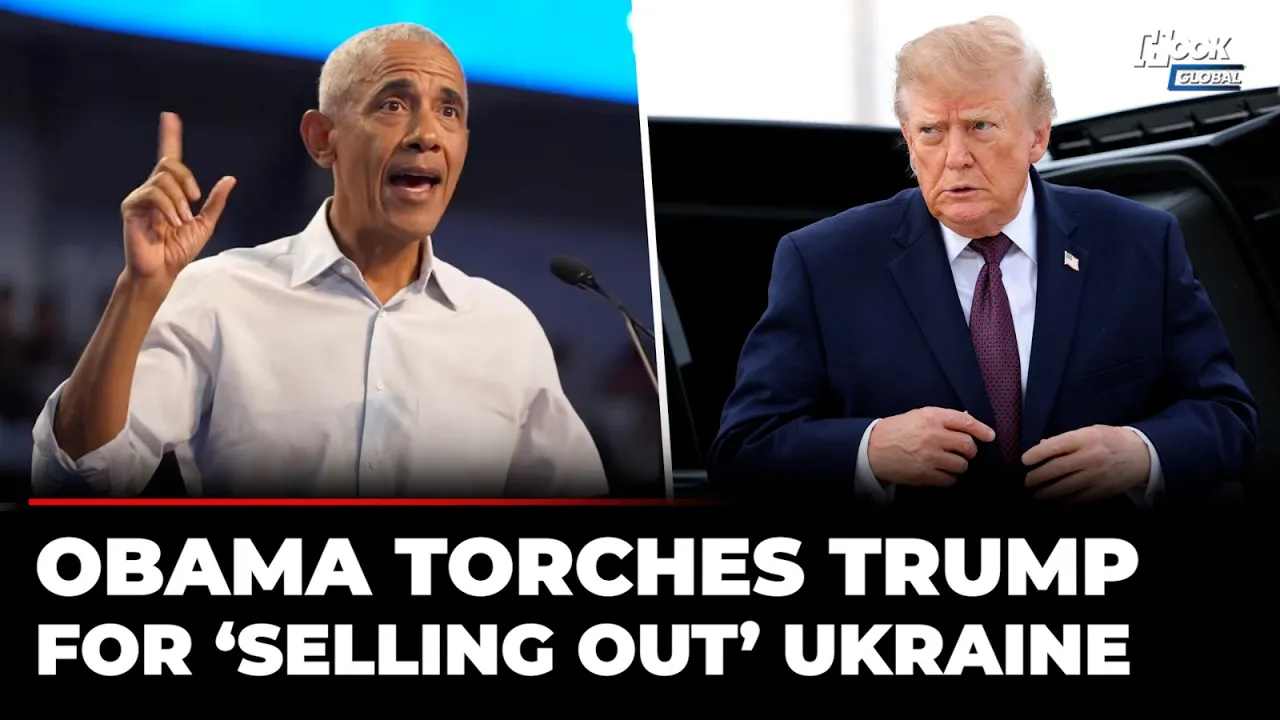
In a searing speech that has reignited the debate over America’s role in the world, former President Barack Obama launched a blistering critique of President Donald Trump’s foreign policy, accusing him of alienating key allies like Canada and “bending the knee” to Vladimir Putin while selling out Ukraine. Obama’s remarks, delivered at a political rally, tied these geopolitical failures directly to the economic pain felt by ordinary Americans, arguing that the administration’s “series of bad decisions” has driven up costs and undermined national security.
Obama’s Sharp Rebuke: Alienating Friends, Appeasing Adversaries
Obama did not mince words. “While we’re alienating key allies like Canada, the White House is bending the knee to Vladimir Putin of Russia and selling out Ukrainians who are fighting for their freedom and democracy,” he declared, drawing loud cheers from the crowd. The former president framed this as a fundamental betrayal of American values and strategic interests. Canada, he noted with irony, is “the nicest people around, our friendly neighbors to the north” — yet the Trump administration’s trade war has turned hockey games into booing contests and strained a historically robust partnership.
At the same time, Obama argued, the administration has taken a soft line on Russia, effectively capitulating to Putin’s agenda. “Bending the knee” is a phrase that evokes submission, and Obama used it to paint Trump as weak on the world stage — a striking inversion of Trump’s “America First” rhetoric. The contrast is stark: while Trump picks fights with Canada, he reportedly seeks accommodation with a Russian leader who has repeatedly undermined democratic norms and violated international law, including the ongoing war in Ukraine.
The Economic Cost of Alienation: Tariffs, Prices, and Broken Promises
Obama’s critique was not limited to foreign policy. He connected the dots between the administration’s actions abroad and the rising costs at home. “First of all, if you thought everything cost too much before, guess what? Everything is more expensive now,” Obama said, listing mortgages, health care, utility bills, and gas prices. He cited gas at “top four bucks a gallon” and diesel over five dollars, pointing to the administration’s own policies as the primary cause.
Central to his argument was the “whole tariff business.” Obama reminded the audience that economists had warned that tariffs would be paid by consumers, and “that’s exactly what happened.” The trade war with Canada — a nation that supplies everything from maple syrup to critical minerals — has raised prices and strained relations. “Rather than having the tariffs bring down deficits like he said he would, we’re now running a debt to the tune of $40 trillion,” Obama said, emphasizing the fiscal irresponsibility of the approach.
Ukraine and the Betrayal of Democratic Values
Obama’s most pointed criticism came on Ukraine. He accused the White House of “selling out Ukrainians who are fighting for their freedom and democracy” while simultaneously “bending the knee to Vladimir Putin.” This, he argued, is not just a moral failure but a strategic one. Ukraine’s fight against Russian aggression is a fight for the principles of sovereignty and self-determination — principles that the United States has historically championed. By cozying up to Putin and abandoning Ukraine, the administration sends a message that America cannot be trusted as an ally.
Obama’s own record on Russia and Ukraine provides a contrast. He reminded the audience of his diplomatic engagement with Iran — “I didn’t have to fire any missiles. I engaged in diplomacy” — to highlight what he sees as a preference for smart power over reckless military adventurism. The implication is clear: Trump’s approach has been neither smart nor principled, but rather a series of impulsive decisions that have left America isolated and less secure.
The Domestic Fallout: Unnecessary Wars and Misplaced Priorities
Obama also took aim at the administration’s domestic priorities, particularly the “unnecessary war that nobody asked for and nobody voted for.” He was referring to the conflict with Iran, which he argued was based on a false premise: “Iran didn’t have nuclear weapons. We had curbed their nuclear program.” The war, he said, has led to attacks on allies and bases, American casualties, and a depleted missile stockpile, making the country more vulnerable. “Iran now has veto power over the Strait of Hormuz, where much of the world’s oil goes through,” Obama noted, directly linking this to higher oil and diesel prices.
Meanwhile, the defense secretary is “laser focused on very important matters like the jawline and testosterone levels of our troops,” Obama joked, before turning serious. “These are not serious people. And we’re all paying the price for their lack of seriousness.” The only significant legislation passed by the administration and its Republican allies, he added, was “a trillion dollar tax break that mostly benefits the richest Americans” — a stark contrast to the urgent need for policies to bring down costs for working families.
Conclusion: A Choice Between Leadership and Retreat
Obama’s speech was more than a partisan attack; it was a call to action. “Do not boo. Vote,” he urged the crowd, emphasizing that the real power lies at the ballot box. His critique painted a picture of an administration that has squandered America’s moral authority, alienated its friends, and emboldened its adversaries — all while failing to deliver on its promises of prosperity and peace.
The former president’s words will resonate with those who believe that America’s strength comes from its alliances and its commitment to democratic values. By alienating Canada and “bending to Putin,” Trump has undermined both. The choice ahead, Obama suggested, is between a return to responsible leadership and a continued retreat into isolationism and authoritarianism. For voters, the message is clear: the consequences of this administration’s actions are not abstract — they are felt at the gas pump, in the grocery store, and in the security of the nation and its allies.


0 Comments