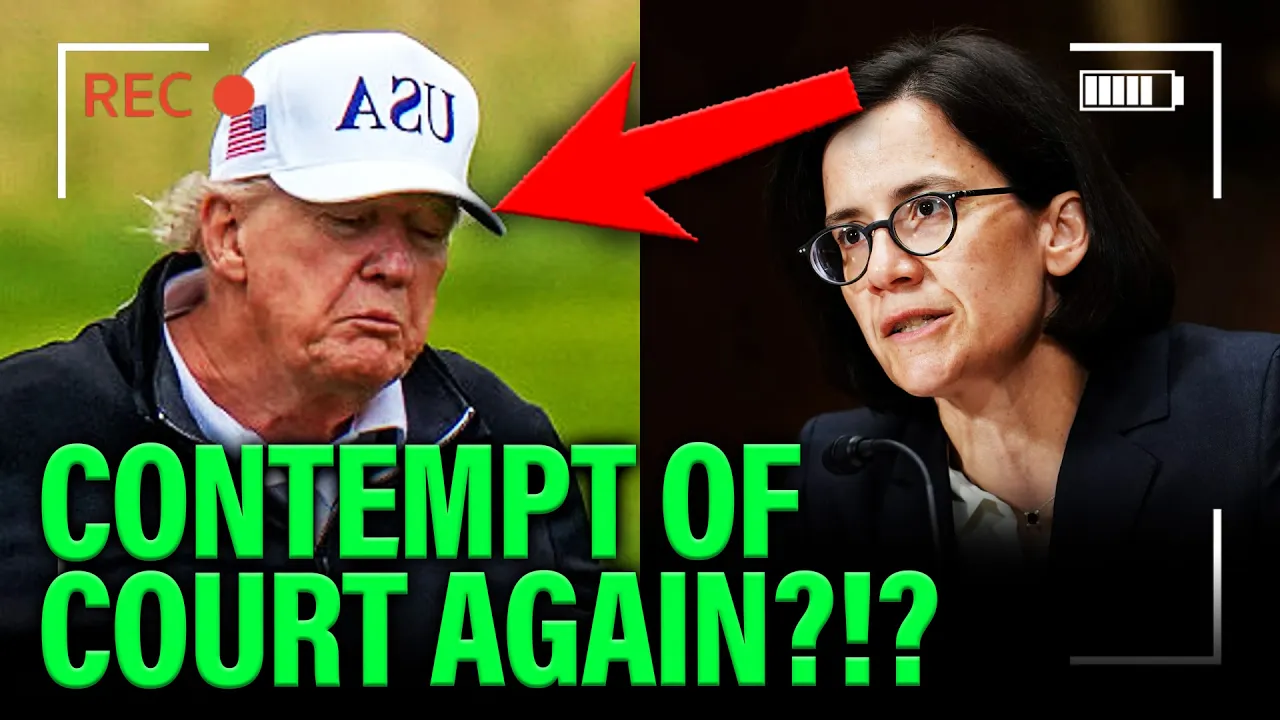
What happens when the lawyer for the government appears before a federal judge and offers assurances that conflict directly with the public statements of the president he serves? That question is now at the center of a remarkable dispute inside a Washington, D.C. federal courtroom, where a judge has ordered the Department of Justice to reconcile two starkly opposite versions of reality. The answer, contained in a new four-page filing, is not a clarification so much as a quiet retreat — and it comes with consequences that may include sanctions, a contempt inquiry, and a growing credibility problem for the attorneys involved.
How the Conflict Began
The case concerns the historic East Potomac golf course, an 18-hole public course on federal parkland operated for decades by the National Park Service. Litigation over the site's future placed the property under the oversight of a federal judge, who issued a preliminary injunction after the government failed to provide the notice her order required. The judge has been monitoring the situation closely, and her patience appears to have worn thin.
During a hearing in her courtroom, the judge engaged in a direct back-and-forth with Associate Attorney General Stan Woodward. She asked whether the course really was set to close on the date the president kept announcing — November 15. Woodward's answer, according to the judge's own memorandum opinion, was explicit: while the president may want the course closed, it was not scheduled to close, and the court should look to the National Park Service rather than the president.
Within days, the president posted on social media that the course was definitely closing on November 15 and that the judge lacked the authority to stop it. That post created an immediate problem. The judge had just been told, as an officer of the court, that no such closure was set. So she issued an order requiring the government to reconcile its courtroom statements with the president's public declarations.
The Response That Made Things Worse
The new filing opens with what can only be described as an admission. The government acknowledges that the president has twice directed the Department of the Interior and the National Park Service to close the park by November 15. That statement directly contradicts what the judge was told in open court, and the judge has the transcript to prove it.
The filing then attempts to thread a needle that does not exist. It explains that Interior, acting through counsel, is working to develop a plan to implement the presidential direction and will provide notice later — presumably when the closure is imminent. In other words, the president has ordered the golf course closed, the government concedes the order exists, but the lawyers insist the matter is not yet final because no plan has been completed.
The distinction may be legally relevant to administrative procedure, but it lands poorly as an explanation to a judge who was told the opposite just days earlier. The filing essentially confirms that the courtroom representation was inaccurate, while avoiding the word "inaccurate." Judges tend to notice that kind of framing.
The Record Retention Fight
A second, related dispute concerns whether the judge should issue a formal order requiring the preservation of documents. The judge has expressed frustration that records in other cases involving the administration have been lost or destroyed. Her concern is not abstract: document retention orders are a standard tool when litigation is ongoing and the stakes are high.
The government's response offers three arguments. First, it says the show cause order is unnecessary because the Department of the Interior and the Department of Justice are already bound by federal record retention requirements. Second, it notes that Interior has placed a litigation hold on the matter at DOJ's request — a step that instructs the agency not to destroy relevant material. Third, it argues that a show cause order directed at DOJ records is inappropriate because DOJ is not a party to the case; it is only counsel.
Each of these points has a counterargument, and the judge likely knows them all. Federal retention rules exist, but documents are still destroyed. A litigation hold instructs against destruction, but it is not self-enforcing. And while DOJ's role as counsel is real, the attorney-client and work product privileges protect records from disclosure — they do not license their destruction.
The filing also had a hurried quality. It contained typos, including a reference to a "show choke cause order," suggesting a filing prepared under pressure and without the usual polish of major appellate work. In a high-profile matter before a judge already asking pointed questions, small errors tend to amplify larger doubts.
The Contempt Question
The most serious portion of the government's filing addresses the possibility of a civil contempt proceeding. The government argues that the court itself acknowledged it never issued a formal order requiring notice, and therefore there was no order that could have been violated. The filing quotes the judge's remark that the only reason she had not yet issued a show cause on contempt was that she had not put the requirement in a formal order.
That quotation, however, does not carry the weight the government places on it. The judge's order required timely notice before any work began on the trees. The government did not provide it, which is why the preliminary injunction issued. And with the new filing conceding the president directed the closure, the factual foundation for a contempt inquiry may have grown stronger rather than weaker.
The government also raises a broader objection: this is an Administrative Procedure Act case involving review of an administrative record, and the court therefore should not conduct a contempt inquiry at all. That argument is technically creative but unlikely to persuade a judge who believes she is defending the integrity of her own docket.
Why This Matters Beyond One Golf Course
At first glance, this is a dispute about a municipal golf course and a seawall crumbling into a river. But the legal principles at issue are considerably larger. When government lawyers make representations to a court, those representations carry weight precisely because they come from officers of the court. If those representations can be reversed by a social media post, the entire mechanism of judicial reliance begins to erode.
The tension here is structural. A president speaks publicly and often bluntly. Lawyers representing the government must translate that rhetoric into litigation positions. When the two diverge, the lawyers face a choice: correct the record, or attempt to reconcile the irreconcilable. The latest filing chose the second path, and the judge has noticed.
There is also the question of notice and process. The judge required advance notice so that she, and the public, would know what the government intended to do before it did it. That requirement exists to prevent courts from being presented with irreversible facts after the fact. The government's approach — announce the closure, sign a new lease with an operator who will cease operating the course, and promise details later — inverts that sequence.
What the Judge Is Likely to Do
The judge has scheduled a hearing and has ordered the government's lawyer to appear in person. That is not a routine step. It signals that she intends to hear directly from counsel about the statements made in her courtroom and the statements made afterward.
Several outcomes are plausible. She may accept the explanation, note her displeasure on the record, and issue a narrow preservation order. She may refer the matter for further inquiry. Or she may conclude that the government's shifting positions warrant a formal contempt proceeding, a step that would escalate the dispute considerably.
What is unlikely is that she will treat the filing as a satisfying answer. The filing acknowledges the presidential directive while insisting no final agency action has occurred — a position that may be legally arguable but factually awkward given the announced closure date and the new lease arrangement that terminates the operator's role.
The Broader Pattern
This episode fits a pattern seen across multiple cases in which courts have struggled to obtain straight answers from government counsel about what the executive branch actually intends. Judges have grown more willing to demand sworn explanations and to impose preservation obligations. The credibility of the lawyers appearing before them is now a recurring issue, not an isolated one.
The government's argument that DOJ records are protected by privilege is legally standard. But privilege disputes are resolved by courts, not by unilateral assertions, and courts have repeatedly ordered production when the privilege was invoked improperly. The government's suggestion that production would be "futile and unwarranted" sidesteps the judge's authority to decide that question herself.
Conclusion
The filing revealed three things. First, the government has conceded that the president twice directed the closure of the East Potomac golf course, contradicting what the court was told in open session. Second, the government is relying on procedural distinctions between a presidential directive and final agency action to avoid immediate compliance with the court's oversight. Third, the government is resisting a formal document preservation order on grounds that the judge has already signaled she finds unpersuasive.
What happens next will depend on how the judge reads the record and how counsel explains the discrepancy in person. But the broader lesson is already clear: a representation made to a federal judge cannot be undone by a press release or a social media post. If the government's words in court and the president's words outside it cannot be reconciled, it will be the lawyers — not the president — who answer for the gap.
The hearing may resolve the immediate dispute, or it may mark the beginning of a longer confrontation over documents, notices, and the limits of executive direction in a case under judicial supervision. Either way, the judge has made one point unmistakable: she intends to get answers, and she intends to get them in her courtroom.


0 Comments