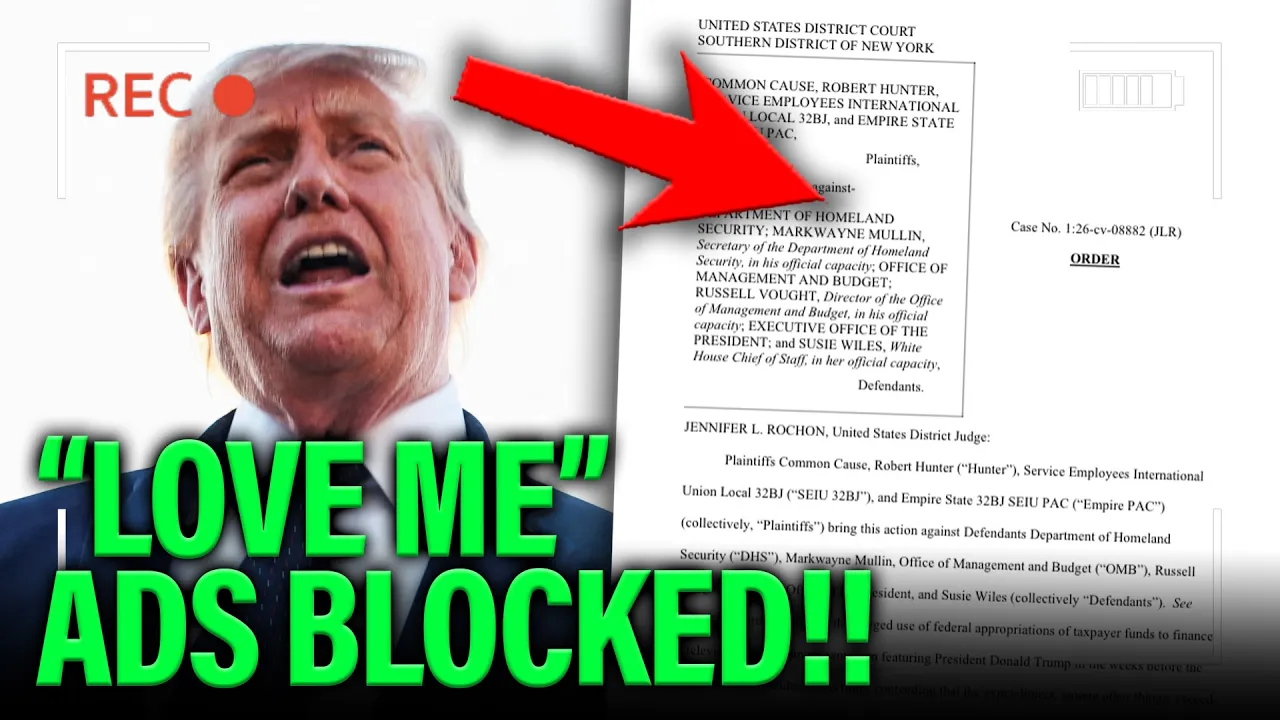
A Federal Judge Drops the Hammer on a Controversial Ad Campaign
In a stunning late-night development that has sent shockwaves through the political establishment, a federal judge in New York has issued an emergency injunction blocking the Trump administration from spending taxpayer dollars on a massive advertising campaign widely seen as an attempt to influence the upcoming midterm elections. The order, handed down by Judge Jennifer Roshan in the Southern District of New York, represents a dramatic legal intervention just weeks before voters head to the polls.
The case, brought by government watchdog group Common Cause along with several labor unions, argued that the administration's use of federal funds to run what critics describe as thinly veiled political propaganda violates multiple federal laws. The judge agreed, finding that the plaintiffs demonstrated a likelihood of success on the merits and would suffer irreparable harm without immediate judicial intervention.
The Ads That Sparked the Firestorm
At the heart of the controversy is a series of television advertisements featuring President Donald Trump that have been airing during high-profile sporting events, including professional and college football games. These ads, which carry messaging reminiscent of campaign spots, have been funded not by a political committee but by the American taxpayer through the Department of Homeland Security.
One particularly controversial ad features dramatic imagery and language about demolishing the so-called "deep state" and expelling "war mongers" from government. The messaging closely mirrors Trump's 2024 campaign rhetoric, raising serious questions about whether government resources are being improperly used to advance partisan political objectives.
What has particularly outraged critics is the apparent scale of the expenditure. While at least $1.7 million has already been spent, the purchase order at issue authorized up to $20 million in taxpayer funds, with indications that the total could eventually reach $50 million. The campaign was reportedly scheduled to continue running right up until the midterm elections, maximizing its potential political impact.
Adding another layer of controversy, the songwriter behind the music used in one of the ads has filed a copyright infringement claim and issued a cease-and-desist order, stating that the use of the song "Love Me" was never authorized for such purposes.
The Legal Battle Unfolds at Breakneck Speed
The lawsuit was filed on October 7th, and the legal proceedings moved with remarkable speed. Judge Roshan held an initial conference on Friday to discuss the request for emergency injunctive relief, recognizing the urgent nature of the situation since the advertisements would continue airing over the weekend.
The court afforded both parties an opportunity to present their arguments and permitted additional time for responses. Briefing concluded by midday on Sunday, October 11th. Based on the materials provided, the judge determined that no additional conference was necessary and issued her ruling late that evening.
In her order, Judge Roshan systematically rejected each of the government's defenses. First, she found that the motion was not moot, rejecting the administration's argument that the ads had already run and the money had already been spent. The plaintiffs presented evidence that the campaign was ongoing and would continue through the election period.
Second, she determined that the plaintiffs had standing to proceed. This was a critical finding, as the government had argued that Common Cause and the labor unions lacked the legal authority to bring such a challenge. The standing doctrine has been a favorite tool of the administration in previous cases, sometimes successfully at the Supreme Court level, but Judge Roshan was not persuaded.
Third, and most significantly, she found that the plaintiffs had demonstrated that they were likely to succeed on the merits of their case. This means the judge believes the evidence supports the claim that the expenditure violates the Administrative Procedures Act and exceeds the constitutional and statutory authority of the presidency.
What the Injunction Actually Does
The temporary restraining order issued by Judge Roshan is comprehensive in scope. Under the authority of Title 5 of the United States Code, Section 705, the order stays the purchase order entered into on or about September 20th between Customs and Border Protection and the advertising agency LMD Incorporated.
Specifically, the injunction blocks all future payments under the purchase order, effectively cutting off the funding pipeline for the ad campaign. The order also stays the Office of Management and Budget's apportionment of $20 million to fund the development, creation, and airing of the advertisements.
The defendants are enjoined from using, dispersing, or transferring funds appropriated to the Department of Homeland Security to develop, create, disseminate, place, distribute, publish, or air the challenged advertisements. Furthermore, they are ordered to cancel any existing slot placements, reservations, or arrangements for airing the ads, including placements scheduled for the evening of October 11th.
The order identifies several specific ad campaigns subject to the injunction, including one titled "The Country He Loves," another celebrating the "Enduring Spirit," and one referred to as the "Final Battle." These advertisements, which had been airing across multiple media markets, must immediately cease.
Judge Roshan's order is effective as of 6:45 PM on October 11th and will remain in effect for 14 days. She has also requested a status report within 24 days and directed that the advertising agency be provided with a copy of the order. The clerk has been instructed to close the motion at docket 25, with future proceedings to be scheduled later.
The Judge at the Center of the Storm
Judge Jennifer Roshan brings an impressive legal pedigree to this high-stakes case. A graduate of NYU Law School, she has built a distinguished career that includes serving as general counsel for the Girl Scouts of America and working at the prestigious law firm Kramer Levin Naftalis & Frankel in New York.
She also served in the Peace Corps, demonstrating a commitment to public service that extends beyond the courtroom. Nominated to the federal bench by President Joe Biden, she has established a reputation for careful legal analysis and independence.
In a twist that adds an almost novelistic quality to the proceedings, Judge Roshan began her legal career as a law clerk for Judge Maryanne Trump Barry, the late sister of Donald Trump. This connection to the Trump family makes her decision to block the administration's ad campaign all the more striking, underscoring that her ruling was based on legal principle rather than personal loyalty.
The Government's Response and What Comes Next
The Department of Justice, represented by the US Attorney for the Southern District of New York, Jamie McDonald, had argued vigorously against the injunction. Their primary defense was that the case was moot because the money had already been spent and the ads had already aired.
The government's opposition papers essentially told the court that there was nothing left to enjoin. However, the plaintiffs, represented by attorneys from Democracy Forward and the Public Integrity Project, presented compelling evidence that the ad campaign was ongoing and would continue costing taxpayers tens of millions of dollars through the election period.
Judge Roshan found the government's mootness argument to be not credible, noting that the evidence clearly showed the campaign was continuing. The administration's other argument, that the plaintiffs lacked standing, was similarly rejected.
The government is expected to quickly appeal the decision to the Second Circuit Court of Appeals, and from there, the case could potentially reach the Supreme Court through Justice Sonia Sotomayor, who oversees the Second Circuit. The legal battle is far from over, and the outcome could have significant implications for the separation of powers and the use of government resources for political purposes.
Broader Implications for Democracy and Accountability
This case raises fundamental questions about the boundaries between governing and campaigning, and about the proper use of taxpayer funds. The principle at stake is straightforward: government resources should be used for government purposes, not to advance the political fortunes of any party or candidate.
Federal law contains numerous provisions prohibiting the misuse of appropriated funds for publicity or propaganda purposes. These restrictions exist precisely to prevent the kind of abuse alleged in this case, where the power of incumbency and the resources of the federal government are weaponized for electoral advantage.
The timing of the ad campaign, running in the final weeks before the midterm elections, strongly suggests a political motive rather than any legitimate governmental purpose. The content of the advertisements, with their campaign-style messaging and focus on the president's personal brand, further supports this conclusion.
If left unchecked, such practices could fundamentally undermine the fairness of elections by giving the party in power an enormous financial advantage funded by all taxpayers, including those who oppose the administration's policies. This is precisely the kind of abuse that the framers of our Constitution sought to prevent through the system of checks and balances.
The Role of Watchdog Groups and the Courts
The lawsuit was made possible by the vigilance of organizations like Common Cause, Democracy Forward, and the Public Integrity Project, which monitor government conduct and hold officials accountable when they overstep legal boundaries. These groups play a vital role in maintaining the integrity of our democratic institutions.
Without such watchdogs, abuses of power could go unchallenged, particularly when the political branches are controlled by the same party and may lack the incentive to police themselves. The courts then become the last line of defense for the rule of law.
Judge Roshan's willingness to act swiftly and decisively in the face of government opposition demonstrates the judiciary's essential function as a check on executive overreach. Her ruling sends a clear message that no one, not even the president, is above the law.
The case also highlights the importance of timely legal action. Had the plaintiffs waited even a few more days, the ads might have completed their run, and the court could have found the case to be genuinely moot. By moving quickly, the watchdogs were able to preserve the ability to challenge the expenditures while they were still ongoing.
Public Reaction and Political Fallout
The injunction has generated significant public interest and debate. Supporters of the administration have criticized the ruling as judicial overreach, arguing that the president has broad authority to communicate with the American people. Critics of the administration, meanwhile, have praised the decision as a necessary check on abuse of power.
The political implications are considerable. With the midterm elections approaching, the administration had hoped to use the ad campaign to boost support for its allies and frame the political narrative. The injunction disrupts those plans and may force the administration to find alternative, legally permissible ways to make its case.
The case also feeds into broader concerns about the erosion of democratic norms and the increasing blurring of lines between official government activity and partisan campaign activity. For many observers, the ad campaign was a particularly egregious example of this trend.
As the legal process unfolds, the case will continue to attract attention and scrutiny. The Second Circuit's review and any subsequent Supreme Court action will be watched closely for signals about how the judiciary will treat similar challenges in the future.
Conclusion
Judge Roshan's emergency injunction represents a significant legal victory for those concerned about the integrity of elections and the proper use of taxpayer funds. By blocking the administration's ad campaign, the court has reaffirmed that the government cannot use its financial power to tilt the electoral playing field.
The case is far from over. The government will likely appeal, and the legal issues involved are complex and consequential. But for now, the ads must stop, and the administration must find another way to make its case to the American people, one that does not involve spending their own money against their will to influence their votes.
The decision also serves as a reminder that courts can act quickly and decisively when the law is being violated and the harm is imminent. Judge Roshan's ruling demonstrates that the judicial branch remains a vital guardian of the constitutional order, even under pressure from the most powerful officials in the land.
As the midterms approach, the case will continue to evolve, and new developments will surely emerge. For those who care about democracy, accountability, and the rule of law, this is a story worth following closely.


0 Comments