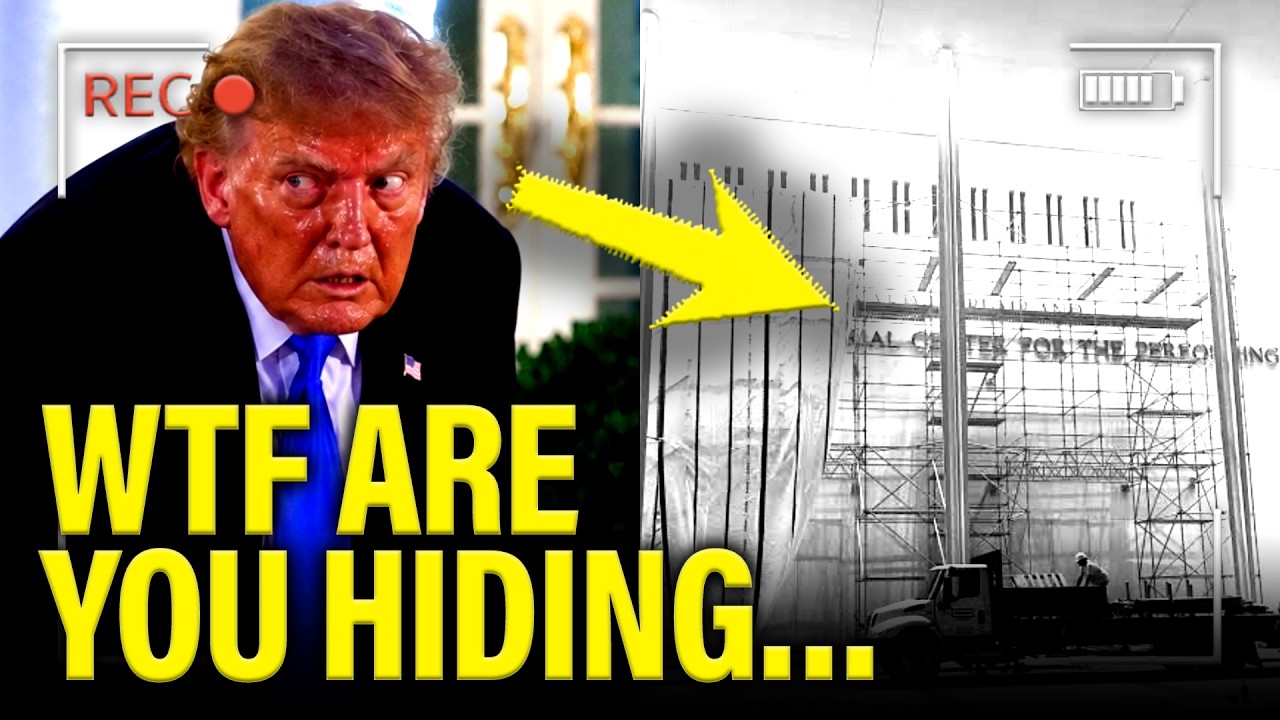
In a stunning legal development, former President Donald Trump and his allies at the Kennedy Center are facing a moment of reckoning. A federal judge has demanded the production of financial documents that the Trump regime claims do not exist. This has sparked a firestorm of controversy, raising questions about transparency, accountability, and the true motives behind the proposed closure of one of America's premier cultural institutions.
The Kennedy Center Under Siege
The John F. Kennedy Center for the Performing Arts, a symbol of American cultural excellence, has become an unexpected battleground. Since Trump's involvement, the center has been embroiled in a series of legal and public relations battles. It all began when Trump attempted to have his name added to the building, a move that was met with resistance and ultimately blocked by the courts.
Not one to back down, Trump then proposed engraving his name on a pavilion, which also failed. In a surprising turn, he then threatened to demolish the building and close it for two years, citing unspecified structural issues. This drastic proposal raised eyebrows and led to a lawsuit to prevent such actions. The court, presided over by Judge Cooper, granted a preliminary injunction, halting any demolition or closure until further review.
The Court's Demand for Evidence
Judge Cooper's latest order is a direct challenge to the Trump regime. The court has demanded that the Kennedy Center board produce financial statements for fiscal year 2026, including income statements, balance sheets, and cash flow reports. The judge expressed skepticism that the center could operate without such basic financial documentation, stating, "The court highly doubts that the center has operated without core financial reporting over the past year."
The Trump regime's response has been evasive. They claim that no such documents exist and that they cannot produce what they do not have. This stance has only intensified scrutiny. Legal experts argue that this is a classic tactic: delay, obfuscate, and avoid accountability. As one observer noted, "They vary between the dog ate it and uh oh, it never existed."
The Fiduciary Duty Question
At the heart of this legal battle is the question of fiduciary duty. Board members of nonprofit organizations are legally obligated to act in the best interests of the institution, making decisions based on sound financial and strategic reasoning. The court is asking for evidence that the board exercised such judgment when deciding to close the Kennedy Center for repairs.
However, critics argue that the board is stacked with Trump loyalists who rubber-stamp his decisions without independent thought. "They have no professional judgment. They just have Trump judgment," said one legal analyst. This lack of independent oversight raises serious concerns about the legitimacy of any closure decision.
The Missing Financials: What Are They Hiding?
The absence of financial documents is suspicious. Nonprofits are required to maintain meticulous records, and the Kennedy Center is no exception. It receives federal funding and private donations, all of which must be accounted for. The court's order is a reasonable request for standard financial reports, not an overreach.
Legal experts suggest that if the Trump regime truly had nothing to hide, they would simply produce the documents. Instead, their refusal suggests that the financials might contradict their claims of impending doom. As one commentator put it, "When they come forward, it always turns out that the documents that exist contradict what the Trump administration has to say."
The Broader Pattern
This case is not isolated. It fits a pattern of behavior seen throughout Trump's career: making bold claims without evidence, then refusing to provide documentation when challenged. From the Epstein files to various lawsuits, Trump has consistently avoided transparency. This has led to a credibility gap that undermines his arguments in court.
The legal system relies on evidence, not assertions. Judges like Cooper are well aware of this pattern and are increasingly demanding concrete proof. The Kennedy Center case is no different. By ordering the production of financial documents, Judge Cooper is ensuring that the rule of law prevails over rhetoric.
Implications for the Kennedy Center
The Kennedy Center is a national treasure. Its closure would be a significant loss for the arts community and the public. The Trump regime's claims of structural issues seem dubious, especially given that the center was operating successfully before Trump's involvement. The politicization of the board has already driven away artists and donors, further harming the institution.
If the court finds that the board breached its fiduciary duties, it could impose penalties or even remove board members. This would be a significant rebuke to Trump and his allies. It would also set a precedent for other institutions facing similar threats.
The Legal Battle Ahead
Judge Cooper has scheduled further hearings to review the financial documents, should they be produced. If the Trump regime continues to stonewall, they could face sanctions for contempt of court. The judge has already shown patience, but that patience may wear thin if the defendants fail to comply.
The case is likely to be appealed, possibly reaching the Supreme Court. The legal arguments will center on the scope of the court's authority to intervene in the internal affairs of a nonprofit board. However, the court's demand for basic financial records is well within its purview, especially when a preliminary injunction is in place.
Public Perception and Political Fallout
The public is watching closely. The Kennedy Center is a beloved institution, and any attempt to close it for dubious reasons is likely to be met with outrage. The Trump regime's refusal to provide financial documents only fuels speculation that they are hiding something.
Politically, this is a lose-lose situation for Trump. If he produces documents that show the center is financially stable, it undermines his justification for closure. If he produces documents that show financial distress, it raises questions about why he mismanaged the center in the first place. If he produces nothing, he appears evasive and possibly guilty of wrongdoing.
Conclusion
The Kennedy Center case is a microcosm of the larger struggle between accountability and authoritarianism. Trump's attempt to assert control over a cultural institution, regardless of the law or the facts, has been met with resistance from the courts. Judge Cooper's demand for financial documents is a crucial step in ensuring that decisions are based on evidence, not whims.
As the legal battle continues, it is clear that the Trump regime cannot simply ignore the law. The missing financials are a glaring red flag, and the court's ultimatum puts the burden squarely on the defendants. They must either produce the documents or face the consequences. In the end, transparency will prevail, and the truth will come out. The American people deserve nothing less.


0 Comments