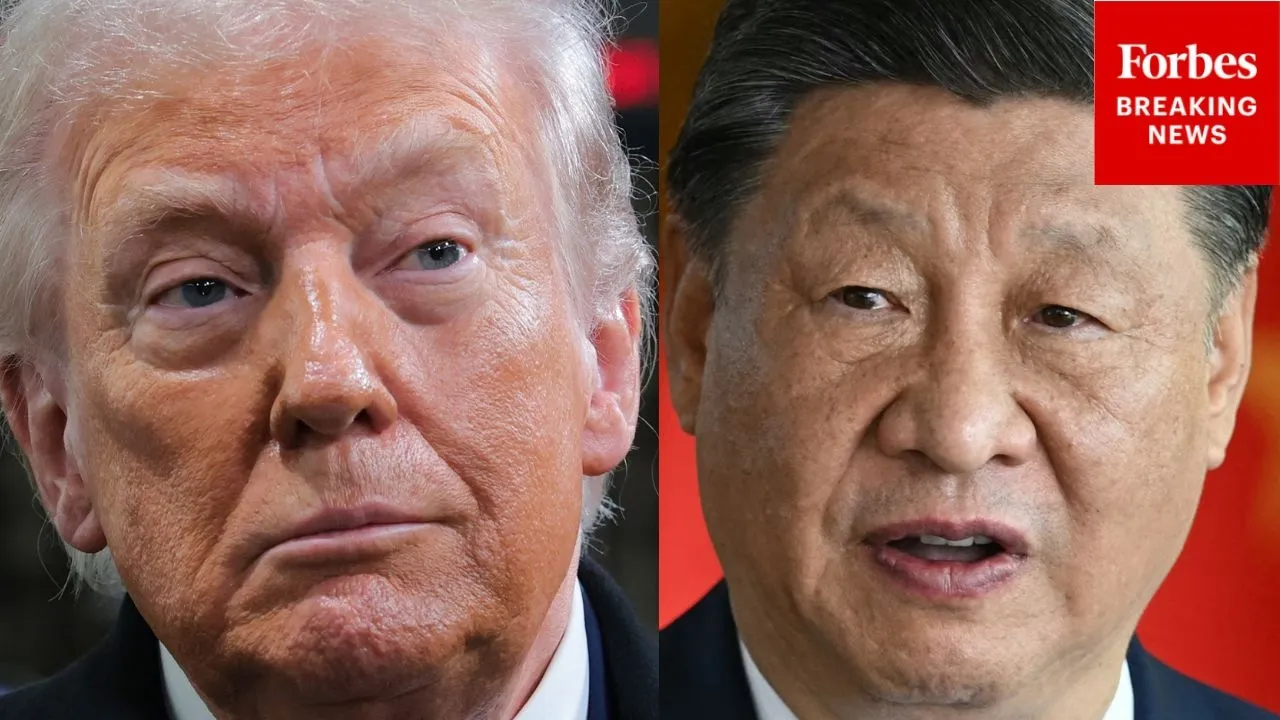
In a speech that has left political observers scratching their heads, Donald Trump made a stunning claim that Chinese President Xi Jinping "was here last week"—a statement that immediately raised eyebrows and prompted a wave of questions about what exactly the former president meant. The remark, delivered during a campaign-style rally, has become the latest in a series of confusing and controversial statements that have come to define Trump's public appearances.
The claim came amid a broader speech in which Trump touched on economic statistics, employment numbers, and his usual criticisms of the Biden administration. But it was the Xi Jinping reference that stole the show, leaving audiences and analysts alike wondering whether it was a slip of the tongue, a deliberate provocation, or something else entirely.
The Context: A Speech Full of Tangents
To understand the significance of the Xi Jinping claim, it's important to look at the broader context of the speech. Trump spent much of his time on stage discussing employment figures and taking credit for economic policies—even those that have long since been superseded by the current administration.
At one point, he declared that "more Americans are working today than at any time in the history of our country," a claim that fact-checkers have repeatedly debunked. He also referenced the departure of over one million federal employees, suggesting that they had all gone on to find better-paying jobs in the private sector—a claim that is difficult to verify and likely exaggerated.
But it was the foreign policy tangent that truly raised alarms. Trump seemed to suggest that a foreign leader—presumably Xi Jinping—had been on American soil recently, a claim that, if true, would represent a major diplomatic event. No such visit has been reported by any credible news source, and the Chinese government has not confirmed any such trip.
Analyzing the Claim: What Did Trump Mean?
There are several possible explanations for Trump's statement. The first and most obvious is that it was simply a verbal slip—a moment of confusion in a long and rambling speech. Trump has a well-documented history of making confusing or contradictory statements, particularly when speaking off the cuff.
A second possibility is that Trump was referring to someone else entirely. Given the context of the speech, which involved a lot of discussion about foreign policy and trade, it's possible that he was attempting to make a point about China and simply misspoke. However, this explanation seems less likely given the specificity of the claim.
A third possibility is that Trump was deliberately making a provocative statement designed to generate headlines. Trump is a master of media manipulation, and he knows that a claim about a foreign leader visiting the United States would be picked up by news outlets across the world. Whether this was his intention or not, the strategy appears to have worked.
- Verbal slip: A moment of confusion in a spontaneous speech
- Misstatement: A reference to a different individual or event
- Provocation: A deliberate attempt to generate controversy and media coverage
- Confusion: A genuine misunderstanding of recent events
The Broader Pattern: Trump's Relationship with Facts
This incident is far from isolated. Trump has a long history of making claims that are not supported by evidence, particularly when it comes to foreign policy and international relations. From his assertions about trade deals to his claims about foreign leaders, Trump has consistently demonstrated a willingness to make statements that are difficult or impossible to verify.
This pattern has significant implications for how the public should interpret his statements. When a political figure repeatedly makes claims that are not grounded in reality, it becomes increasingly difficult to distinguish between what is true and what is merely convenient.
Critics have argued that this pattern is dangerous, particularly when it involves matters of national security. If a former president is making false claims about foreign leaders, it could create confusion and mistrust among allies and adversaries alike. It could also undermine the credibility of the United States on the world stage.
The Xi Jinping Question: A Diplomatic Riddle
If Xi Jinping had indeed visited the United States last week, it would be a major diplomatic event. Such a visit would likely involve high-level meetings, extensive security arrangements, and significant media coverage. The fact that no such visit has been reported suggests that Trump's claim is either false or based on a misunderstanding.
China and the United States have a complex and often fraught relationship, characterized by trade tensions, strategic competition, and human rights concerns. Any high-level visit would be carefully choreographed and widely publicized, not something that would happen quietly or without notice.
It's also worth noting that Trump's claim comes at a time of heightened tension between the two countries. The Biden administration has taken a firm stance on China, and any suggestion of a secret or unreported visit would be highly unusual and potentially destabilizing.
Media Reaction: A Firestorm of Speculation
The media reaction to Trump's claim was swift and intense. News outlets across the political spectrum picked up the story, with many expressing confusion and skepticism. Some commentators suggested that the claim was evidence of cognitive decline, while others argued that it was simply another example of Trump's unconventional communication style.
Social media was also ablaze with speculation, with users offering a wide range of theories about what Trump might have meant. Some suggested that he was referring to a different foreign leader, while others speculated that he was making a joke or a sarcastic comment that was taken out of context.
Regardless of the explanation, the incident has become a talking point in the ongoing debate about political rhetoric and the importance of accuracy in public discourse. In an era of misinformation and fake news, the stakes are higher than ever.
Fact-Checking the Claims: What We Know
To date, there is no evidence to support the claim that Xi Jinping visited the United States last week. The Chinese government has not confirmed any such visit, and no credible news outlet has reported on it. The White House has also not commented on the claim.
Trump's other claims—about employment numbers, federal employees, and economic statistics—are also questionable. Many of the statistics he cited are either outdated, misrepresented, or simply false. This pattern of exaggeration and misinformation is concerning, particularly given the influence that Trump continues to wield in American politics.
It's important for the public to approach such claims with skepticism and to rely on credible sources of information. In a time when misinformation can spread quickly and easily, critical thinking and media literacy are more important than ever.
The Political Implications: A Distraction or a Strategy?
Trump's claim about Xi Jinping comes at a critical moment in American politics. The 2024 election is on the horizon, and Trump is positioning himself as a leading candidate for the Republican nomination. His speeches are closely watched by supporters and opponents alike, and every statement he makes is dissected and analyzed.
Some analysts have suggested that Trump's confusing statements are part of a deliberate strategy to dominate the news cycle. By making provocative or controversial claims, he ensures that he remains the center of attention, even when the substance of what he's saying is questionable.
Others have argued that these statements are a sign of a deeper problem—a declining ability to communicate clearly and accurately. This is a concern that has been raised by mental health professionals and political commentators alike, though it's important to note that diagnosing cognitive decline from afar is both difficult and ethically questionable.
Conclusion: A Reminder to Stay Informed
Trump's claim that Xi Jinping "was here last week" is a striking example of the confusion and misinformation that can arise in the current political climate. Whether it was a slip of the tongue, a deliberate provocation, or a genuine misunderstanding, it underscores the importance of fact-checking and critical thinking.
In a world where information is abundant but not always accurate, it's essential to rely on credible sources and to question claims that seem implausible. The stakes are too high to do otherwise.
As the political landscape continues to evolve, the public must remain vigilant and informed. The ability to distinguish truth from fiction is not just a civic duty—it's a necessity.


0 Comments